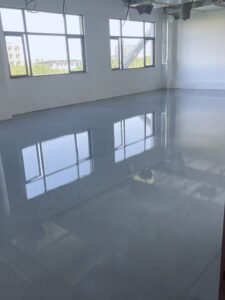
In the modern dry-mix mortar industry, Gypsum-Based Self-Leveling Compounds have become the premier choice for large-scale floor preparation due to their exceptional volume stability, quick traffic time, and near-zero chemical shrinkage. However, application contractors and blending plants frequently encounter critical surface defects during installation, most notably bleeding, segregation, and the dreaded “alligator skin” or wavy wrinkling upon drying.
These surface failures do not merely ruin the visual aesthetics; they severely compromise the core mechanical properties of the floor. When a self-leveling slurry bleeds, excessive water transports fine polymers and chemical retarders directly to the top layer. This creates a brittle, weak “dead ash layer” that crusts prematurely due to ambient airflow, blocking the moisture evaporation path of the core matrix. As the core continues to cure and shrink underneath, the crust buckles and cracks, leading to systemic hollow-bumping and surface powdering.
The Rheological Flaw of Conventional Formulations
Traditionally, many dry-mix plants rely heavily on standard High-Viscosity Cellulose Ethers (HPMC) to provide water retention. While HPMC locks in water efficiently for static wall applications like troweling skim coat, it behaves poorly under high-fluidity, self-leveling conditions. Standard HPMC fails to deliver sufficient yield stress and high suspension capability when the water-to-binder ratio fluctuates. Under mechanical pumping, the bone aggregates (sand) rapidly sink to the bottom, while the water and bleeding fine materials bleed to the surface.
The Hosechem Breakthrough: Structural Suspension Engineering
To completely eradicate systemic cracking and surface skinning, the R&D team at Hosechem (Zhejiang Hongsheng Chemical Co., Ltd.) introduces a revolutionary fluidic solution: Hosechem DG-150D Polysaccharide-based Ultra-High Suspension Stabilizer.
Unlike traditional cellulose matrices, DG-150D is specifically engineered to completely replace unoptimized HPMC in self-leveling systems. It operates on an advanced macromolecular spatial-hindrance network. When added at a minimalist dosage of $0.6 – 1.0 \text{ kg/ton}$, it constructs a temporary, highly resilient suspension array throughout the slurry cross-section.
The primary technical advantages of integrating Hosechem DG-150D include:
-
Massive Water-Tolerance Window: It securely bonds water molecules and inorganic binders together, maintaining absolute consistency even under extreme industrial water fluctuations ($20 – 80 \text{ kg/ton}$).
-
Synchronous Homogeneous Drying: By drastically decelerating the surface skinning rate, it ensures that the self-leveling layer dries at an identical speed from core to surface, resulting in a flawless, mirror-smooth finish completely free of wave wrinkles.
-
Perfect Aggregate Suspension: Paired with our HS-618 High-Strength Polymer Binder, it locks heavy sand aggregates seamlessly in place, guaranteeing a verified 28-day compressive strength exceeding $21 \text{ MPa}$ without risk of bottom segregation.
For global flooring distributors and dry-mix plants looking to elevate their product line, switching to a dedicated suspension flow modifier is the definitive step toward zero-claim, premium floor installations.
Building Global Excellence Together