
Why Low Ash Content and High Film Flexibility Dictate Underlayment Longevity.
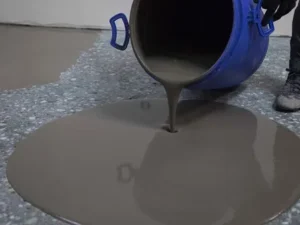 When it comes to preparing subfloors for PVC tile, rubber running tracks, or premium epoxy地坪 coatings, Ultra-Thin Cementitious Self-Leveling Underlayments ($2 – 5\text{mm}$) are irreplaceable. They must provide an impeccably level, highly resilient substrate over existing concrete. Yet, engineering a reliable $3\text{mm}$ cement layer is one of the most chemically demanding tasks for dry-mix formulators.
At a nominal thickness of just $2-5\text{mm}$, the surface-area-to-volume ratio of the applied slurry is exceptionally massive. Moisture evaporates into the atmosphere and leeches into the porous concrete base at an accelerated pace, leaving the cement matrix with insufficient water to complete proper hydration. As the thin layer dries under intense shrinkage stress, immense shear forces accumulate at the interface. Without a specialized high-polymer binding agent, the underlayment will cleanly tear away from the old substrate, generating disastrous hollow delamination and large-scale cracking.
The Danger of High-Ash Composite Polymer Powders
To cut costs, many blending plants adopt low-grade or composite polymer powders. Calcined data reveals that these unverified binders contain an inert mineral filler (such as heavy calcium carbonate or talc) concentration exceeding 40% to 50%.
High ash content means low pure polymer concentration. Within the ultra-short hydration window of a thin-bed self-leveling compound, these extended powders are utterly incapable of coalescing into a continuous matrix. Instead of reinforcing the floor, they disrupt the cementitious crystal matrix, leading to a brittle substrate that breaks under light mechanical traffic.
Elevating Bond Strength with Hosechem HS-7080
International standards, such as EN 13820 and ISO 13007, mandate that tensile bond strength is the true benchmark of floor longevity—compressive strength merely determines how much vertical load the floor can bear, but bond strength determines if the floor will stay attached.
To satisfy the stringent specifications of global technical procurement managers, Hosechem offers its flagship HS-7080 Premium Flexible Redispersible Polymer Powder (RDP).
Engineered with a strict calcined ash content tolerance restricted to $11 \pm 2\%$, HS-7080 delivers an unadulterated VAE polymer mass above 88%. When specified at a minimalist dosage of $4 – 5 \text{ kg/ton}$, its micro-scale polymer liquid droplets coalesce instantaneously upon water contact. They form an extensive, highly flexible polymer bridge network woven throughout the mineral crystals.
Key performance benchmarks of Hosechem HS-7080 include:
-
Direct International Benchmarking: Its physical performance parameters and elongation capabilities directly match or exceed mainstream European tier-1 brands, making it an ideal high-efficiency alternative for global formulations.
-
Dynamic Shear Absorption: The continuous elastic latex film acts as a micro-shackle that absorbs horizontal drying shrinkage vectors, translating them into durable, long-term tensile adhesion.
-
Alkali & Hydrolysis Resistance: The VAE polymer structure is highly resistant to the intensely alkaline environment of cement paste, ensuring the underlayment remains bonded for decades without degradation.
For comprehensive protection, Hosechem engineers recommend pairing the HS-7080 formulation with a low-viscosity flow agent, such as our DG-200M (400 mPa·s Special Cellulose), to secure premium water retention without impeding the slurry’s natural self-leveling extension.
Building Global Excellence Together