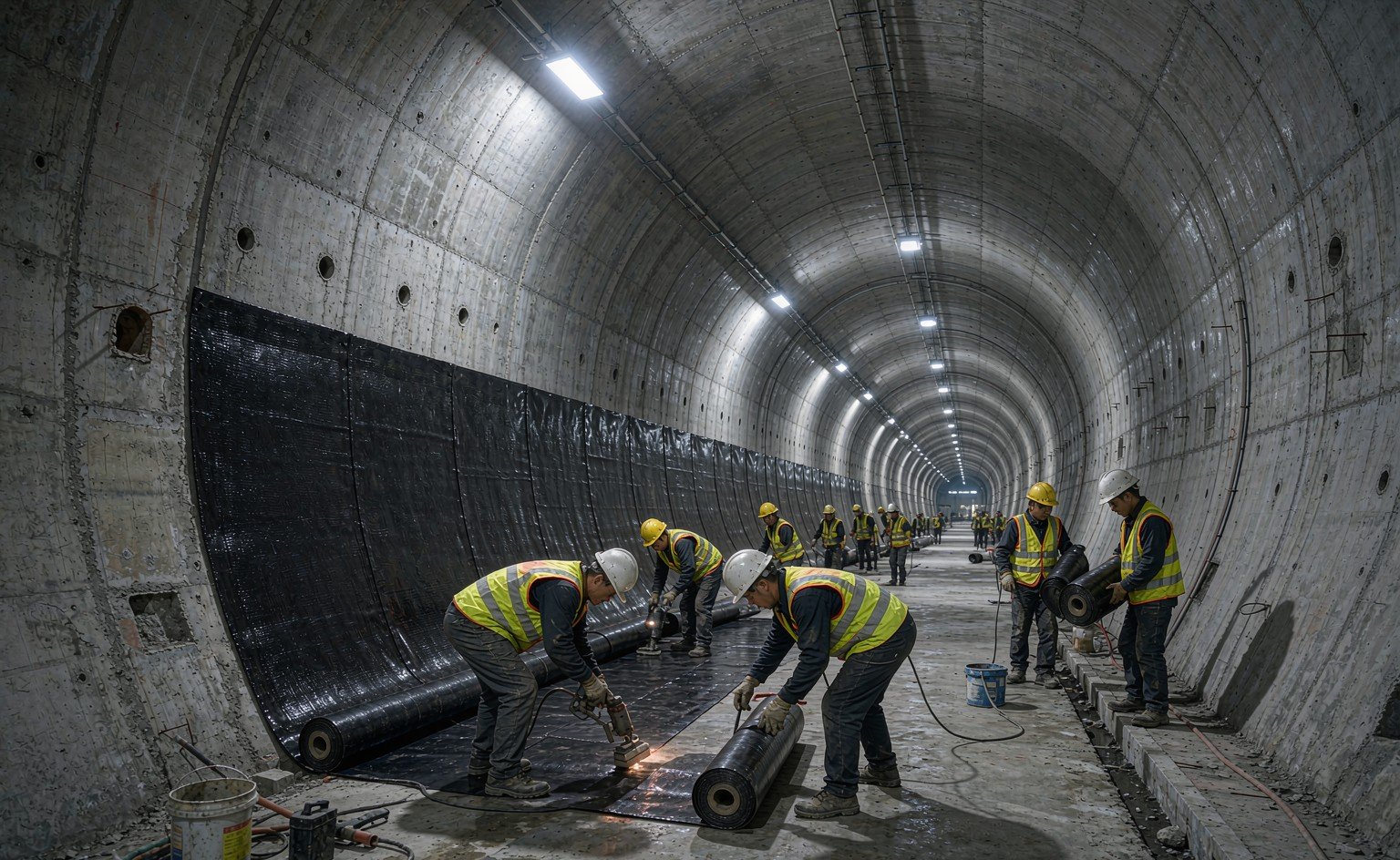
October 2026 has become a defining month for the underground construction sector. The British Tunnelling Society (BTS) Conference & Exhibition, held at the QEII Centre in Westminster, London on 6-7 October, drew more than 800 tunnelling professionals and over 55 global industry brands – an increase on the previous year. Days later, the 18th AFTES International Congress opened at Lille Grand Palais in France from 12-14 October, gathering the European underground construction community around the future of tunnels and subterranean infrastructure.
For manufacturers and suppliers of construction chemicals – from waterproofing admixtures to concrete admixtures and specialty mortars – these events confirm a clear trend: underground infrastructure is now one of the most demanding and fastest-evolving segments for chemical building solutions.
Saint-Gobain Consolidates Its Underground Construction Chemicals Platform
At BTS 2026, Saint-Gobain Construction Chemicals (SGCC) presented its integrated portfolio under the theme "Durable & Sustainable Protection for Tunnels", bringing together three acquired brands – Chryso, GCP and Fosroc – on a single stand. Highlights included:
- TYTRO SL 500 – a new low-odour spray-applied waterproof membrane for confined tunnel environments
- INTEGRITANK waterproofing systems for tunnels and underground structures
- Proofex Engage and Proofex Alkorplan membrane systems
- Specialist sealants such as Nitoseal MS600 and Flamex MS320
- Tunnel-lining admixtures including Chryso Optima 1000, Chryso Eclipse and Chryso Daraset
The division, which now operates in 76 countries, has grown through a series of strategic acquisitions over the past four years – Chryso, GCP and Fosroc among them – and covers the entire structure lifecycle, from groundworks to long-term protection and recycling. At AFTES 2026 in Lille, the same portfolio was presented with technical sessions sharing lessons learned from the Grand Paris Express and Toulouse Metro projects, two of Europe’s largest current underground schemes.
Waterproofing Admixtures: A Market Moving From Surface to Integral Protection
Underlying these showcase events is a structural shift in the waterproofing market. According to recent analysis from Dimension Market Research, the global waterproofing chemical admixture market is projected to reach USD 7.6 billion in 2026 and USD 15.6 billion by 2035, a compound annual growth rate of 8.3%. Key drivers include:
- Labor economics: a severe shortage of skilled membrane applicators is pushing contractors toward integral admixtures dosed at the batching plant rather than post-applied membranes
- Retrofit demand: renovation of aging infrastructure, with mandatory waterproofing beneath new structures codified in more markets
- Self-healing technology: crystalline admixtures that seal micro-cracks autonomously are moving from niche to specification standard
- North America leads adoption with a 38.4% share in 2026, driven by residential basement integral waterproofing and infrastructure renewal
The crystalline waterproofing segment alone is forecast to grow from USD 2.69 billion in 2026 to USD 5.27 billion by 2035 (7.6% CAGR, Next Move Strategy Consulting), with the Middle East & Africa the fastest-growing region at 10.5% CAGR and India the fastest-growing country at 12.6%. Analysts note that Sika’s second-generation crystalline admixture, launched in February 2025, delivered a 32% improvement in permeability reduction – evidence that innovation cycles in this segment are accelerating.
Technology Trends to Watch in Tunnel and Below-Grade Applications
- Digital concrete monitoring: integrated sensor systems for early-age strength and temperature control in precast segments and sprayed concrete
- Nano-silica densifiers: admixtures that reduce capillary porosity and chloride ingress in marine and groundwater-exposed structures
- Powder-form dominance: powder admixtures are favored for ready-mix logistics and dosing precision, while liquid forms gain share in automated precast batching
- AI-assisted formulation: predictive modeling of crystal formation and slump loss is shortening admixture development timelines
- Low-carbon specification: tunnelling clients increasingly demand admixtures compatible with blended cements and LC3-type binders
What This Means for Dry-Mix Mortar and Additive Suppliers
The underground boom has direct implications across the wider construction chemicals value chain. Tunnel segments, shotcrete and precast plants are heavy consumers of cellulose ethers (HPMC, HEMC, HEC) for water retention and workability in repair mortars, tile adhesives and grouts, and of redispersible polymer powders (RDP) for flexibility and adhesion in waterproof slurries and bonding mortars. Spot pricing for construction-grade HPMC in China remained broadly stable through early October 2026 (domestic 100,000-viscosity grades around RMB 12,000-15,000 per ton), keeping input costs predictable for mortar formulators even as demand from infrastructure projects climbs.
For formulators and distributors, three practical takeaways stand out:
- Specify for durability, not just application: underground clients now ask for measurable self-healing crack-width tolerance and long service life
- Compatibility testing is becoming mandatory: admixture-cement and admixture-binder interactions with blended cements must be validated at the batching plant
- Regional supply resilience matters: with demand concentrated in APAC, North America and the Gulf, reliable multi-region sourcing of cellulose ethers and RDP is a competitive advantage
Looking Ahead
As urbanization pushes infrastructure underground – metros, utilities, data-center foundations and water tunnels – the construction chemicals industry is responding with integrated, low-odour, self-healing and digitally monitored systems. Suppliers who combine consistent raw-material quality with technical service will be best positioned as specification practice shifts from surface treatments to integral protection.
Need reliable HPMC, HEMC, HEC or RDP supply for your mortar and admixture formulations? Hosechem provides high-performance cellulose ethers and redispersible polymer powders for dry-mix mortars, tile adhesives, waterproof mortars and concrete admixture applications, backed by consistent quality and export experience worldwide. Contact Hosechem today to request technical data sheets and free samples for your next underground or infrastructure project.
Published October 2026.