The construction chemicals industry in mid-August 2026 is defined by a paradox at the heart of Europe’s chemical sector, a technology shift opening entirely new additive demand streams, and market data confirming the structural strength of dry-mix mortar chemistry. BASF’s sweeping CoreShift restructuring is rewriting the competitive map even as the company posts its strongest quarter in years. At the same time, 3D concrete printing (3DCP) is crossing from pilot projects into serial commercial deployment, creating fresh specification pull for superplasticizers, viscosity-modifying agents, and accelerators. And the dry-mix mortar additives market continues its steady expansion, with cellulose ethers holding firm as the formulation backbone.
BASF CoreShift: 7,000 Jobs Cut, Ludwigshafen at Lowest Headcount Since 1954
On July 28, 2026, BASF confirmed what industry observers had been tracking for months: its Ludwigshafen flagship site employed fewer than 30,000 full-time workers for the first time since 1954. CEO Markus Kamiith stated that the pace of workforce reduction accelerated sharply in 2026, with the first half of the year alone accounting for more job cuts than the previous two years combined. Since January 2024, BASF has eliminated approximately 7,000 positions globally, roughly two-thirds of them in Germany. Global headcount fell 14.4% year-on-year to approximately 94,900 by the end of June 2026.
The restructuring is driven by the deep structural crisis in European chemicals: persistent demand weakness, elevated energy costs, and intensifying competition from Asian producers. Ludwigshafen has posted losses for four consecutive years. In May 2026, BASF launched the CoreShift program, targeting up to a 20% reduction in fixed costs across its core business segments by 2029. The program covers chemicals, materials, industrial solutions, and nutrition and care businesses with combined sales of approximately EUR 40 billion. It includes further headcount reductions and the relocation of back-office functions to India.
Yet the paradox is that BASF’s Q2 2026 operating performance was unexpectedly strong. Quarterly sales rose 16% year-on-year to EUR 17.2 billion, driven by rising demand and significant price increases. Adjusted EBITDA reached EUR 2.4 billion, up 53.6% year-on-year. Customer inventory build-ups linked to concerns about Strait of Hormuz supply disruptions boosted plant utilization at Ludwigshafen. BASF raised its full-year 2026 EBITDA guidance to EUR 6.9 to 7.7 billion, up from the previous range of EUR 6.2 to 7.0 billion, and announced a share buyback program of up to EUR 1 billion.
Simultaneously, BASF continues to invest aggressively in China. The Zhanjiang integrated site in Guangdong, a EUR 8.7 billion investment and BASF’s largest overseas project, reached full production in March 2026. BASF expects 75% of global chemical industry growth through 2035 to come from China, making the Asia-Pacific capacity build-out central to its long-term strategy.
What this means for construction chemicals: The CoreShift program will likely concentrate BASF’s construction solutions portfolio on higher-margin, specification-driven products. European customers should expect tighter lead times and potentially reduced product ranges for commoditized additive grades, while Asian customers benefit from expanded Zhanjiang capacity. The competitive gap between European and Asian production costs continues to widen, favoring China-based cellulose ether and RDP suppliers in global export markets.
3D Concrete Printing Crosses the Commercial Threshold
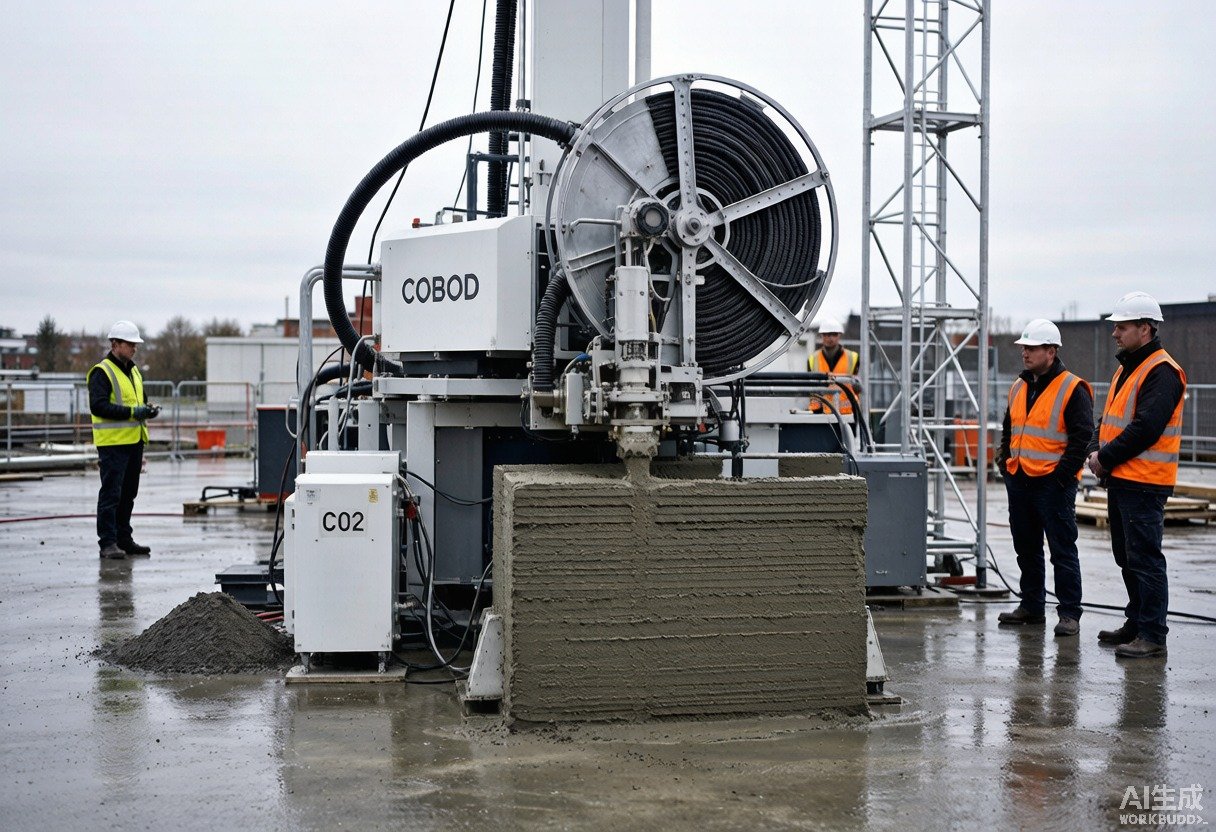
3D concrete printing is moving from experimental showcases to serial production, and with it comes a new wave of demand for specialized construction chemicals. Several milestones in 2026 mark this transition:
- June 2026: Zueblin/STRABAG completed the shell of a 1,700-square-meter supermarket near Stuttgart using a 3D concrete printer, demonstrating large-format non-residential execution at commercial scale.
- April 2026: Holcim used its TectorPrint range with COBOD technology to complete a 12-unit residential building in Bezannes, France, showcasing low-carbon printed construction.
- June 2026: Portuguese contractor Havelar completed a 500-square-meter public building for the municipality of Matosinhos in just 9 days using a COBOD BOD2 printer.
- 2026: American contractor FMGI announced a fleet of 3D printing robots for more than a dozen Walmart construction projects across the United States.
The regulatory framework is also maturing. The ICC 1150-2026 standard provides a compliance anchor for automated construction of 3D concrete walls, while ISO/ASTM 52939:2023 offers broader process guidance. The EU Construction Products Regulation is being revised with digital compliance elements, including a Digital Product Passport expected to become mandatory for construction products by 2028 to 2030.
For additive suppliers, 3DCP creates demand for a distinct chemistry package that differs from conventional ready-mix or dry-mix formulations:
- Superplasticizers (PCE): Essential for achieving pumpable flowability at very low water-to-binder ratios while maintaining shape stability after extrusion.
- Viscosity-modifying agents (VMAs): Critical for controlling thixotropy, ensuring the printed layer is fluid enough to pass through the nozzle but stiff enough to support subsequent layers without deformation.
- Accelerators and retarders: Used to tune setting time for continuous print cycles, preventing cold joints during long print runs while achieving early green strength.
- Defoamers: Powder defoamers reduce entrapped air in dry-mix 3D printable mortars, improving compressive strength and surface quality.
- Polypropylene fibers: PP microfibers bridge micro-cracks from plastic and drying shrinkage, a critical need given the high surface-to-volume ratio of printed elements.
Sika’s Sikacrete 3D product line exemplifies the integrated approach, offering one-component and two-component systems with patented mixing stations and printing heads. The company’s EP 3898558 A1 patent extends printable-mix open times to four hours, a significant advantage in hot-climate printing. As 3DCP scales, chemical suppliers who can co-develop validated mix designs with printer OEMs will capture the premium specification tiers.
Dry-Mix Mortar Additives: Cellulose Ethers Lead a USD 9.8 Billion Market
New market intelligence confirms the structural growth trajectory of dry-mix mortar additives. Fact.MR values the global dry-mix mortar additives and chemicals market at USD 5.7 billion in 2026, growing to USD 9.8 billion by 2036 at a 5.6% CAGR. The Business Research Company offers a broader scope at USD 26.44 billion in 2026, reaching USD 35.16 billion by 2030 at 7.4% CAGR. The divergence reflects different segment definitions, but both confirm strong, sustained expansion.
Key segment insights from the Fact.MR analysis include:
- Cellulose ethers hold 35.0% of additive type share in 2026, driven by the irreducible need for water retention and workability in cement-based products.
- Tile adhesives account for 37.0% of application share, reflecting the global expansion of floor and wall installation systems.
- Residential construction captures 41.0% of end-use share, supported by housing repair and new-build activity.
- Polymer modification technology holds 36.0% of chemical technology share as producers seek improved bond strength and water resistance.
Country-level growth rates paint a clear picture of regional dynamics. China leads with a 6.4% CAGR through 2036, followed by India at 6.1%, Germany at 5.8%, and the United States at 5.4%. The Fact.MR report emphasizes that specification-led purchasing is raising the value of supplier documentation, with repeat sales depending on stable quality and clear technical data sheets.
Meanwhile, the cellulose ether market continues its broader expansion. Landcel estimates the global cellulose ether market at USD 7.96 billion in 2026, up from USD 7.38 billion in 2025, with an 8% CAGR projected through 2032 to reach USD 12.8 billion. Construction accounts for over 65% of total demand, with HPMC remaining the most in-demand product. The top 10 manufacturers now hold over 60% of global capacity, with Chinese companies accounting for more than 45% of global production.
PCE Feedstock Prices Stabilize in East China
Ethylene oxide (EO), the primary feedstock for polycarboxylate superplasticizer (PCE) monomers, held stable in East China through early August 2026. As of August 5, 2026, East China EO listed at RMB 7,600 per metric ton, with Satellite Chemical quoting RMB 7,700/t, South China at RMB 7,400 to 7,500/t, and North China at RMB 7,400/t. The 3-month average price stands at RMB 7,218/t, placing current pricing in the low-to-mid range on a one-year basis.
The stability follows a significant rally in late July, when EO prices rose from RMB 6,400 to 6,500/t in late June to RMB 7,300 to 7,600/t by the end of July, reflecting tighter spot supply and improved downstream demand. For PCE formulators, the current EO price level translates into stable monomer costs for HPEG, TPEG, and EPEG macromonomers.
The PCE market itself continues its robust growth trajectory. Dataintelo and Coherent Market Insights cluster the 2026 PCE market valuation in the USD 7.0 to 9.2 billion range, with forecasts converging on USD 12 to 14 billion by 2033 to 2034 at CAGRs of 5.7% to 8.1%. Asia-Pacific holds approximately 47% of global PCE demand, with China’s 7,000-plus commercial ready-mix plants and India’s INR 111 trillion National Infrastructure Pipeline serving as the primary volume engines. Liquid PCE formulations dominate with 68 to 72% market share due to universal compatibility with automated batching plant systems.
Key Takeaways for Industry Participants
- BASF’s CoreShift signals a structural shift in European chemicals production. Construction chemicals buyers should expect tighter product portfolios, longer lead times for commoditized grades, and growing competitive advantage for Asia-based suppliers.
- 3D concrete printing is no longer experimental. The commercial milestones of 2026 create a new demand vector for specialized additive packages, with PCE superplasticizers, VMAs, and accelerators at the core.
- Cellulose ethers remain the formulation backbone of dry-mix mortar, holding 35% of additive share. HPMC and HEMC demand is structurally supported by tile adhesive and residential construction growth.
- EO feedstock prices have stabilized at RMB 7,600/t in East China, providing a predictable cost basis for PCE monomer procurement through August.
For formulators, contractors, and procurement teams navigating this landscape, the strategic priorities are clear: diversify supply chains across European and Asian sources, invest in specification-grade additive portfolios that align with 3DCP and low-carbon concrete trends, and lock in long-term agreements for cellulose ether and PCE supply before the next demand cycle tightens.
At Hosechem, we supply a comprehensive range of construction chemicals, including HPMC, HEMC, HEC, RDP, PCE, CMC, PP fiber, defoamers, PVA, and gypsum retarders, designed to meet the evolving demands of modern construction. Whether you need water-retention agents for machine-applied renders, redispersible polymer powders for high-performance tile adhesives, or superplasticizers for low-carbon concrete, our team is ready to support your formulation needs. Contact Hosechem today to discuss your requirements and request product samples.